
Is LinkedIn to Resume, by CVGist safe on LinkedIn?
10K+
0.1.8
2025-12-02
One-click to turn your LinkedIn profile into an amazing resume. Fast, easy, and free.
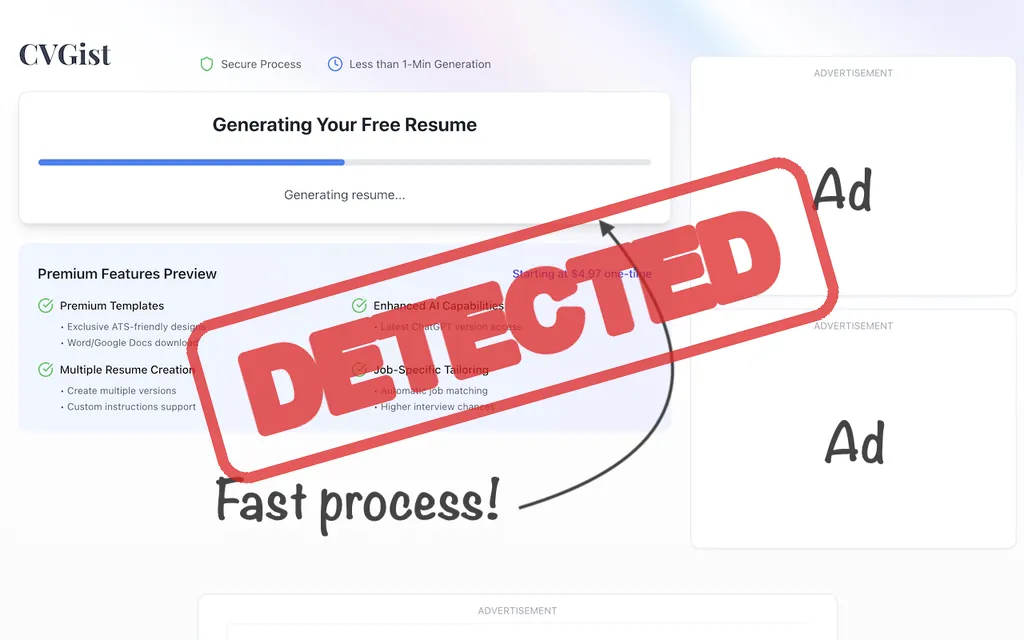
This browser extension is actively compiled into LinkedIn's frontend detection lists. LinkedIn's scripts can detect when this is active on your browser.
What this means: detection isn't an instant ban — it's one input to LinkedIn's risk score. But it's a standing signal: it stacks with your behavior (volume, programmatic clicks) and device fingerprint, and this is just the AED list — one of LinkedIn's three detection systems (see how it works).
There's no 'authorize with LinkedIn' step anywhere. Simplified from its manifest — here's what actually happens between install and your first page load.
Permissions granted on install:
3 permissions requested — no LinkedIn login involved
That verdict isn't a guess. This is what LinkedIn's own page code does on every visit — simplified from its production bundle, which the BrowserGate investigation reverse-engineered line by line:
// chrome-extension://bhdcmampnnhholkenaahdeaddmodmeem/icons/icon.png
We downloaded LinkedIn to Resume, by CVGist's published Chrome Web Store package, de-minified it, and read it file by file — no live LinkedIn login. Two ways to see how:
Downloaded straight from the Chrome Web Store — the exact file your browser would install.
Where your session and data actually go, reconstructed from LinkedIn to Resume, by CVGist's code. LinkedIn to Resume, by CVGist keeps your session in your browser — it calls LinkedIn's Voyager API using your own csrf token, and only uploads results.
red = your session/data leaving your machine · blue/green = stays local or only results leave · dashed = LinkedIn's own detection probes
LinkedIn doesn't need to know anything about proxies to catch this — it just needs one login cookie answering from two networks at the same time.
LinkedIn to Resume, by CVGist keeps your session on your own device, so there's only ever one network this login answers from — there's nothing here for LinkedIn's parallel-access check to catch.
We measured real exit-IP reputation for 7 vendor clouds in a dedicated study — LinkedIn to Resume, by CVGist's own infrastructure wasn't in that sample. The mechanism a session-upload creates is identical regardless: two networks, one cookie.
Does LinkedIn detect LinkedIn to Resume, by CVGist? What we found in its code
Everything we confirmed in LinkedIn to Resume, by CVGist's code, grouped by what it means for your account. Red = strongest detection / risk signals, amber = notable, grey = neutral or local-only.
Runs locally — session stays in your browser · on LinkedIn's detection list
Signals LinkedIn's own page scripts can pick up directly on every visit — the extension probe (AED), code injected into the page (Spectroscopy), fake (isTrusted:false) clicks, blocked/missing telemetry, and cloud remote-control. Each adds points to its risk score.
How the tool touches your LinkedIn login. If it uploads your session cookie to the vendor's cloud, the vendor can act as you from another IP — LinkedIn's loudest parallel-access tell. Reading the cookie locally (csrf/Voyager) is far less risky.
Every outbound destination found in the code — your session / scraped data, plus analytics, CRM pushes and CAPTCHA-solving services. LinkedIn can't see these, but it's where your data actually ends up.
Chrome permissions the extension was granted on install. The highlighted ones are the powerful kind — cookies (read your session), webRequest/declarativeNetRequest (watch & rewrite traffic, incl. blocking LinkedIn's telemetry), scripting/tabs (inject into pages).
How many times each tell-tale pattern appears in the extension's code — the raw proof behind everything above (e.g. li_at = session-cookie reads, voyager/csrf = LinkedIn API calls, synthetic_event = fake clicks, recaptcha = challenge handling).
Even after a cookie is copied out, LinkedIn keeps one more receipt on every request that follows — a 48-point snapshot of the exact machine making it. Faking it convincingly means reproducing that machine's quirks, not just editing a string.
Press play to run the scan. These are illustrative values — this demo never reads your actual device.
LinkedIn to Resume, by CVGist — FAQ
Is LinkedIn to Resume, by CVGist safe to use on LinkedIn?
Our static code audit rates LinkedIn to Resume, by CVGist MEDIUM risk. It works through your own logged-in browser session — your cookie stays on your machine and only scraped results are uploaded — which is safer than cloud tools that take your session. It is still a Chrome extension LinkedIn can detect, and its ID is on LinkedIn's detection list.
Does LinkedIn detect LinkedIn to Resume, by CVGist?
Yes. LinkedIn to Resume, by CVGist's extension ID is on LinkedIn's active extension-detection (AED) list, so LinkedIn's page code probes for it on every visit (it requests the file icons/icon.png) — LinkedIn knows the extension is installed before you do anything.
Can LinkedIn to Resume, by CVGist get my LinkedIn account banned or restricted?
Detection isn't an instant ban — LinkedIn scores accounts on many cumulative signals. But LinkedIn to Resume, by CVGist stacks a known extension ID on LinkedIn's list, code injected into the page, programmatic (isTrusted:false) clicks, and independent reviews report restrictions and permanent bans for Chrome-extension automators. Safe daily limits reduce the behavioral risk but can't offset a detectable architecture.
Does LinkedIn to Resume, by CVGist have access to my LinkedIn account?
It reads LinkedIn data through your own browser session (the Voyager API) and uploads only the results — your session token itself stays on your machine.
How does LinkedIn to Resume, by CVGist work — is it a Chrome extension or a cloud tool?
LinkedIn to Resume, by CVGist is a extension (local PDF capture, no session access) that runs inside your own Chrome browser.
What is a safer alternative to LinkedIn to Resume, by CVGist?
A standalone desktop app such as Linked Helper removes the two extension-specific detection surfaces: there is no Chrome-Store ID for LinkedIn's AED scanner to probe and nothing injected into the page for its DOM scan, and your session never leaves your machine. No tool is unbannable, but the surface it exposes is far smaller.
This one's detectable. Switch to the desktop app — and get 20% off.
The one tool we tore down that isn't a browser extension at all — so it leaves LinkedIn the smallest surface to detect.